
Leadership & KI
The meaning of meaning
Why it is becoming the art of leading modern organizations – a reframing.

“Meaning” Prompted by AIdentity-Engine. Rendered by DALL·E 4.
What Is Actually Holding Organizations Back Today
“What is this supposed to mean?” — a question we don’t ask only in the context of abstract creation. Meaning is not a diffuse concept. On the contrary, it is one of the most effective steering mechanisms in human systems. And yet, in the economic context, it has long been pushed to the margins. In management and investor logic, meaning tends to appear where it is expected – in culture, purpose, or leadership. Important, yes. But supposedly not precise enough to steer decisions.
This is precisely where the structural misunderstanding lies. As long as meaning is treated as something contextual, it remains outside of operational control. It has an effect – but it does not guide. Organizations today are not losing speed or effectiveness because they lack data, tools, or intelligence. They are losing it because meaning is not systemically anchored. What truly slows companies down today is not a lack of information, not a lack of tools, and certainly not a lack of ambition — but the absence of systemically structured meaning in governance. And this bottleneck does not diminish with the proliferation of AI tools; it intensifies. Especially when linear planning logics collide with exponential dynamics.
Let’s start with semantics …
Although commonly understood that way, “meaning” is not a synonym for purpose. It is neither opinion nor value judgment. It simply describes a relationship: the connection between information, context, and decision-making. Information, by itself, carries no meaning. Only in the context of a goal, a role, and a concrete decision does it become relevant – or meaningless. Meaning is therefore not content, but a process of selection.
It determines which information becomes actionable – and which does not. When we translate this into real-world economic practice, a costly oversight becomes apparent.
In classical corporate management, meaning primarily appears in soft contexts: mission statements, visions, purpose declarations, cultural narratives. It is meant to provide orientation, foster identification, and generate motivation. This isn’t wrong – but it remains structurally ineffective as long as meaning stays outside of operational control. It is communicated, but not managed. Described, but barely fed back into processes. Desired, but insufficiently operationalized. Meaning thus remained a byproduct of leadership – not its structural foundation.
A well-known paradox
As early as the 1980s, economics encountered a puzzle that remains unsolved to this day.
Robert Merton Solow, one of the most influential economists of the 20th century and recipient of the Nobel Prize in Economic Sciences (1987), investigated the role of technological progress in driving economic growth. His work laid the foundation of modern growth theory – and led to a surprising observation. In 1987, Solow formulated a sentence that made economic history:
“You can see the computer age everywhere – but in the productivity statistics.”
The statement was provocative: despite massive investments in IT, measurable productivity gains lagged behind expectations. Technology was visible – but its impact was barely noticeable: the “productivity paradox.”

Robert Merton Solow (1924–2023)
More than thirty years later, this paradox has only deepened.
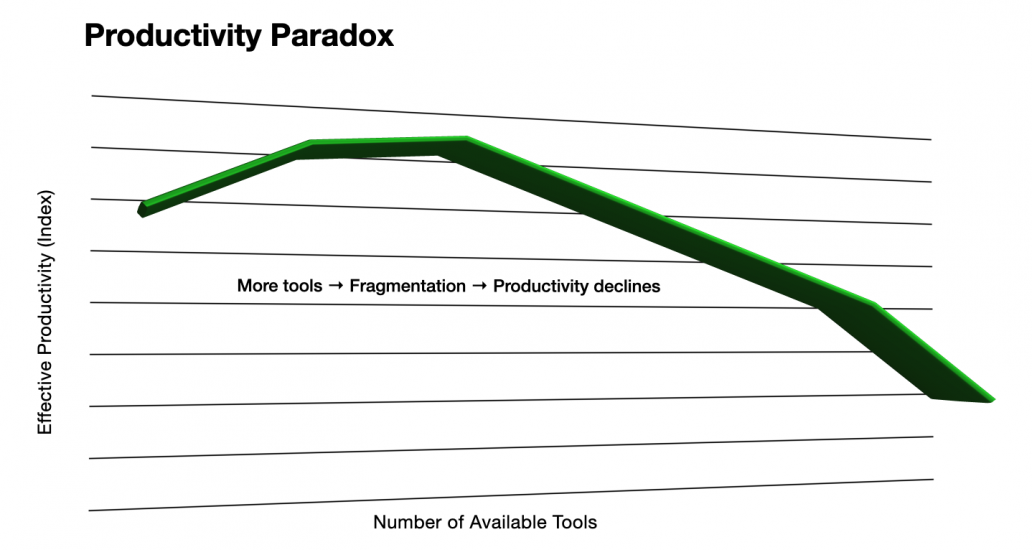
Never before have companies had access to so many tools, data sources, and AI systems. And yet, decisions are being made more slowly. Alignment takes longer, strategies lose clarity, and organizations are becoming increasingly reactive rather than coherent. The root cause is not a lack of technology – but the inability to systemically translate technological intelligence into effective decision-making.
Artificial intelligence is currently amplifying the productivity paradox instead of solving it.
- More information generates more options.
- More options require more alignment.
- More alignment slows down decisions.
It is precisely under the conditions of AI that Robert Merton Solow’s observation is being confirmed today – in a new and intensified form. A development Solow – who passed away in 2023 – did not live to witness, yet whose structural logic he had already described with precision decades earlier.
Three factors are currently fueling this development:
Decision Delay.
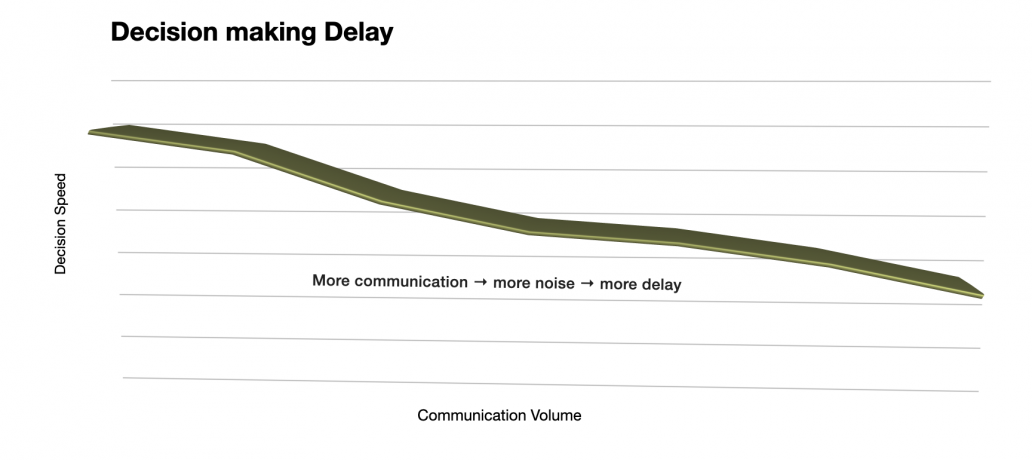
The central productivity issue in modern organizations is not a lack of options – but their overabundance. Digital systems, data platforms, and AI are constantly generating new courses of action: scenarios, recommendations, simulations, forecasts. What was intended as decision support is increasingly turning into decision overload. Organizations become options-rich but decision-poor.
The resulting decision delay (latency) is not a leadership issue at the individual level, but a systemic effect. The more simultaneous options are available, the greater the need for alignment on goals, priorities, responsibilities, and timelines. Decisions do not move faster through organizations – they circulate longer. In this state, productivity does not fail due to a lack of intelligence, but due to a lack of selection logic.
Der Moat Shift.
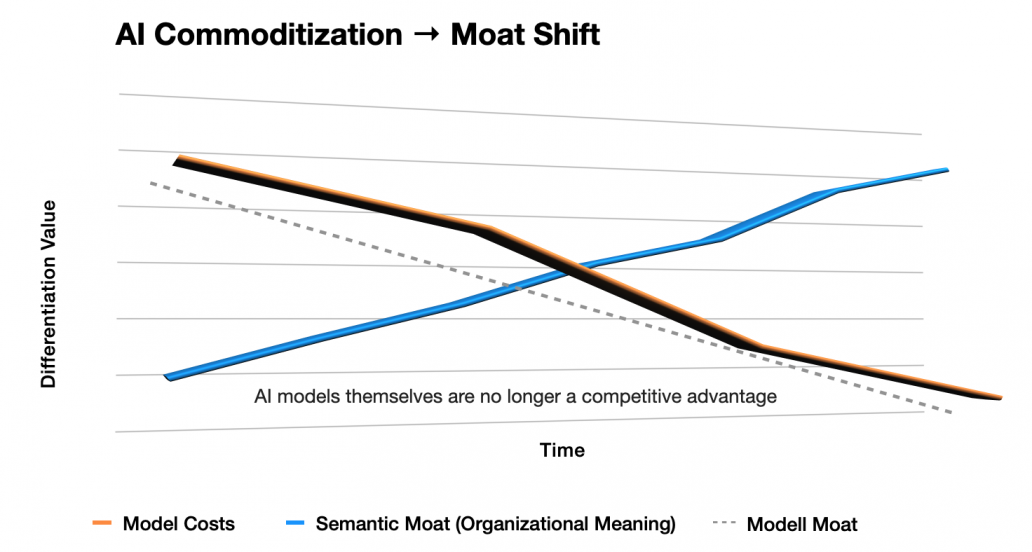
The Moat Shift is not a technological phenomenon, but an economic one. AI models, tools, and platforms are converging. Performance becomes scalable, interchangeable, and globally accessible. Technology is becoming a commodity. In this new reality, the sustainable competitive advantage is shifting fundamentally: from access to technology to the ability to manage it effectively. The key question is no longer who owns the best AI – but who decides faster, more coherently, and more resiliently. It is precisely at this point that meaning becomes the bottleneck of modern organizations – and thus a critical factor in the global economy.
The bottleneck does not lie in the technology itself.
It lies in organization, coordination, and decision-making capacity. Where intelligence is not systemically framed, prioritized, and contextualized, technological capability turns into organizational friction. Without a guiding layer of meaning, complexity grows faster than impact – and progress remains visible, but without consequence.
Because where meaning is lacking, data, options, and analyses may be generated – but no actionable orientation emerges. Decisions become fragmented, coordination slows down, and strategic energy dissipates. Productivity is optimized locally, while systemic impact fails to materialize.
In our world, where technological intelligence is abundant, competitiveness is no longer determined by computing power or the number of AI tools – but by the ability to create, stabilize, and translate meaning into consistent decisions.
Meaning thus becomes the new economic infrastructure – invisible, yet decisive.
“When technology becomes a commodity, meaning becomes the currency of strategic competitiveness.”
Michael Heine / CVO AIdentity
The End of Linearity
Much of today’s corporate management is based on an implicit assumption: that organizations can be managed linearly.
Past data is analyzed, patterns are identified, decisions are made – with the expectation that the future can be understood as a continuation of the past. This model worked in stable, predictable markets. But in dynamic, highly interconnected systems, it fails. This form of management is like trying to steer a race car through winding roads while constantly looking in the rearview mirror. The data may be accurate – but it reflects a reality that is already gone.
AI amplifies this problem.
It makes analysis faster – but not more current. It optimizes patterns whose validity may already have expired. A phenomenon we refer to as the “rearview mirror problem.” The faster the system becomes, the riskier linear backward control (looking behind) gets.
“In nonlinear systems, orientation does not arise from prediction – but from situational relevance.”
Ibo Sy / CTO AIdentity
It’s not the question “What was?” that matters, but “What matters now?”
This is precisely where meaning begins to fulfill its true function.
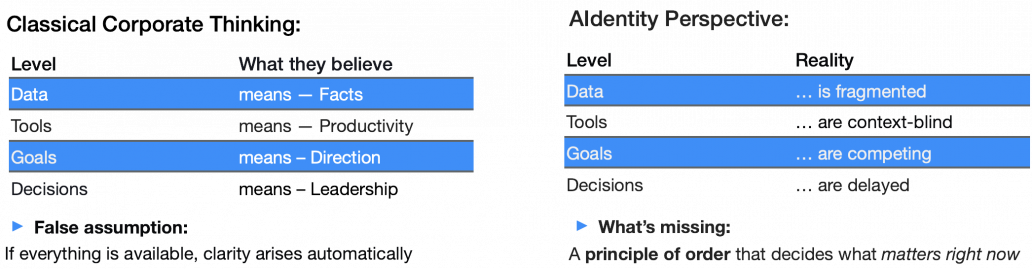
Classical Corporate Thinking – and Its Limits
Many organizations implicitly follow a simple assumption:
If enough data is available, the right tools are used, clear goals are defined, and competent people make decisions, orientation will emerge.
Reality looks different:
- Data is fragmented.
- Tools are blind to context.
- Goals compete with each other.
- Decisions are delayed – not due to a lack of competence, but due to a lack of clarity.
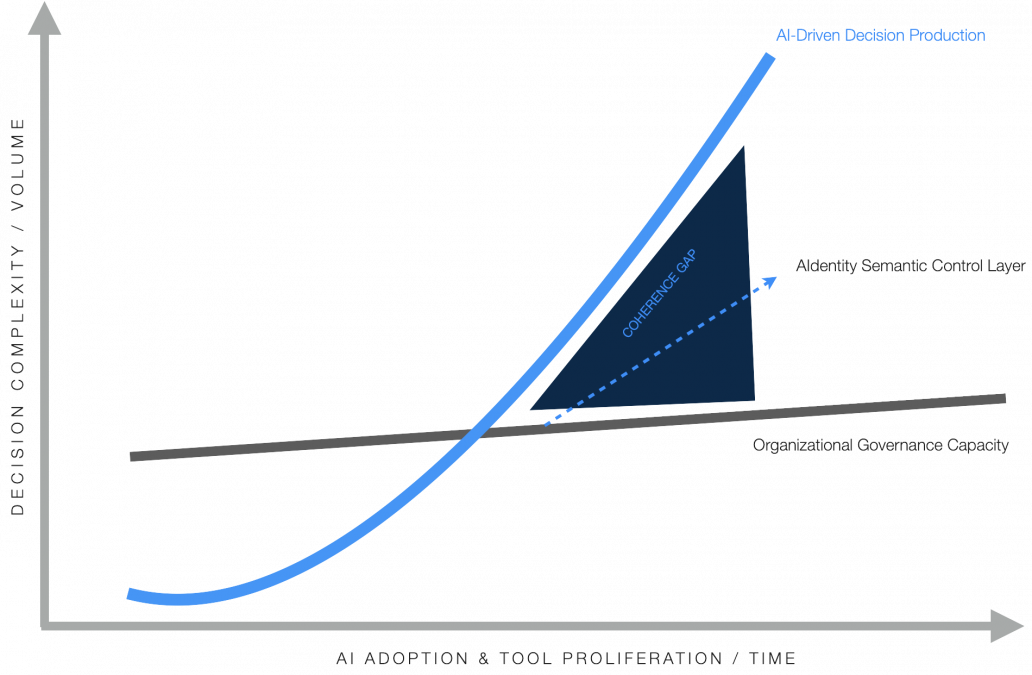
What’s missing is a principle of order – one that determines, in the moment, what is relevant – in short: what is meaningful.
That’s not something a tool can provide – it requires identity, context, and priority. That’s what AIdentity delivers.
The Coherence Gap / ®2025 AIdentity
The AIdentity Perspective:
It’s not about new tools – but about the structure above them.
Data, tools, goals, and decisions still exist. What matters, however, is how they are connected.
AIdentity views meaning not as an asset, but as a state that is situationally generated within the system.
From this perspective, a clear distinction emerges:
- Information as raw material
- Knowledge as structured information
- Meaning as knowledge in the context of a decision
- Experience as meaning that has proven itself in action
Meaning is a dynamic system performance.
Systemically translated:
Meaning does not emerge once. It must be continually regenerated. It is dependent on situation, time, role, and goals.
That’s why meaning cannot be stored – only regulated.
It continuously determines:
- Which information is relevant now?
- What knowledge is decision-capable?
- Which perspective takes priority?
- What can be ignored?
Meaning is what legitimizes attention.
From a cybernetic perspective, meaning is a second-order control variable. It does not directly steer actions, but rather governs the selection of information that is permitted to become action-relevant. In doing so, meaning operates at the level of system orientation – not system execution.
It fosters coherence over reaction and enables connectivity instead of actionism. Meaning is situational, context-dependent, and tied to roles and goals. It arises systemically – not individually.
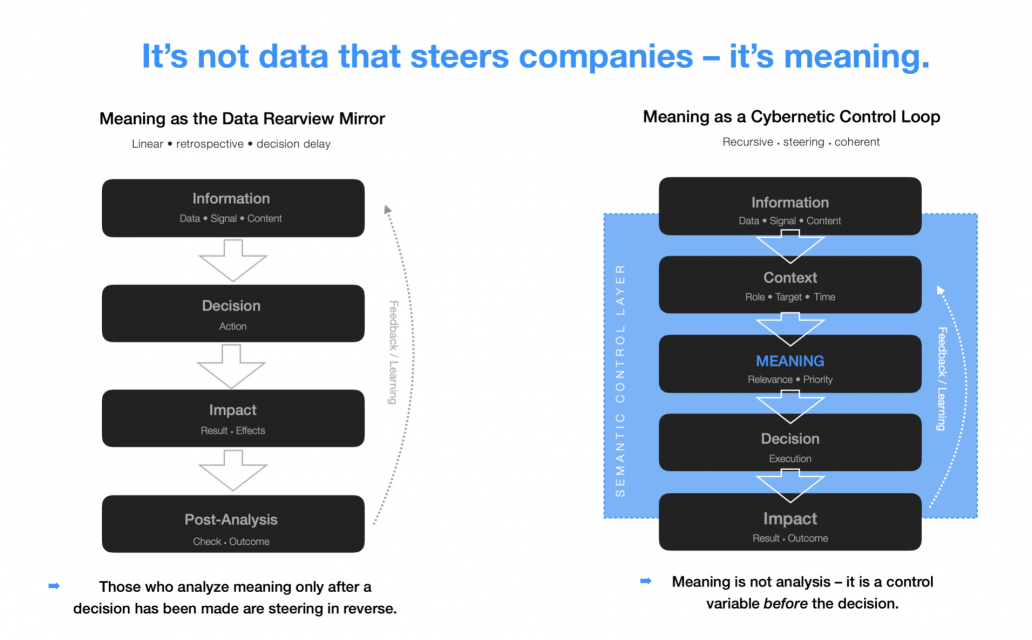
AIdentity® / Cybernetic Control Model
Companies today are not losing because they lack tools, data, or AI — but because meaning is not being systemically managed.
Meaning as the Leadership Resource of the Future:
Linear planning does not fail due to a lack of intelligence, but because meaning does not emerge linearly. In a world of permanent information availability, success is no longer determined by knowledge – but by the ability to generate meaning. Organizations that master this ability systemically make decisions faster, more consistently, and with greater future resilience.
Meaning is information that has become action-relevant. It is what remains when information fades. And what remains determines whether organizations lead into the future – or are swallowed by the noise of information.
The Critical Question…
… is not how well companies analyze – but how they generate meaning before decisions are made.
In complex organizations, meaning today mostly arises implicitly – dispersed across meetings, hierarchies, tools, and individual interpretations. It is: fragmented, contradictory, and time-delayed. That’s exactly why more data, more AI, or faster analyses alone are not enough.
They often only reinforce an existing pattern:
Decision situations are generated more efficiently — but decisions are not made more coherently.
What’s missing is not another system for processing information. Successful organizations need a system that explicitly structures meaning –
an Operating System (OS) that doesn’t leave context, relevance, and priority to chance, but treats them as controllable variables – before the decision, not after.
This is exactly where AIdentity / OS comes in.
Not as a tool, not as an analytics platform, and not as a substitute for AI – but as a Semantic Control Layer for organizations.
AIdentity / OS makes visible which meaning is currently in effect, why certain information becomes decision-relevant – and how this logic of meaning evolves continuously through feedback. This shifts the focus of organizational intelligence: away from the optimization of evaluation, toward the steering of orientation. The meaning of meaning, then, does not lie in its philosophical depth – but in its operational impact.
- Those who manage meaning systemically don’t just decide faster – they decide better, more coherently, and more future-ready.
AI tools accelerate organizations. AIdentity prevents them from outpacing themselves in the process.
Meaning as the New Productivity Infrastructure
At the macroeconomic level, the developments outlined here signal a profound shift in the logic of productivity growth.
For decades, technological progress was seen as the primary driver of economic performance. Investments in IT, automation, and digitization were expected to deliver efficiency gains, growth, and competitiveness. But as Robert Merton Solow already demonstrated, the diffusion of technology alone does not automatically translate into measurable productivity gains.
With artificial intelligence, this dynamic reaches a new level. AI scales cognitive capacity almost without limit – and in doing so, levels out technological advantages between companies, industries, and economies. Access to intelligence becomes global, fast, and comparable.
When intelligence scales globally, meaning becomes the decisive resource of economic productivity.
This signals a shift in the bottleneck of productivity growth: away from the sole question of technological investment, toward the ability of organizations and institutions to effectively coordinate that intelligence.
Economic progress will increasingly depend on how well decisions are synchronized across systems – between companies, supply chains, markets, and policy frameworks.
In this context, meaning becomes the productive prerequisite for impact. It determines which information becomes actionable, which priorities take precedence, and how quickly collective decisions become connectable. Where this layer of meaning is missing or fragmented, friction, delays, and growth stagnation arise – even in the presence of high technological capability.
In a world driven by AI, macroeconomic success is no longer primarily determined by technological superiority, but by the ability to systemically generate meaning – and translate it into coherent action. Productivity growth becomes a question of collective steering intelligence – and AIdentity is the first mover of this decisive infrastructure.
In short:
The next stage of productivity will not be programmed. It will be decided systemically.